Hello! I am Juanma Nieto, Head of Branding, Web Design, and Digital Marketing at WeLoveWeb. If you are reading this, it is likely because you have noticed that we no longer search the same way we did five years ago. We no longer just type individual words into a bar: now we speak to our phone, watch, or the kitchen speaker while we are preparing dinner.
“Hey Siri, find an SEO agency in Spain.” “Alexa, what is the best restaurant in Madrid?” These interactions are the present and, above all, the immediate future of organic search. In this article, I would like to walk you through everything you need to know about SEO and voice search, from user psychology to the technical adjustments that will make your website the one selected by Google’s algorithms, Alexa, and the rest.
The paradigm shift: From “keywords” to conversation
When we type, we are lazy. We write “buy running shoes”. But when we speak, we are natural and detailed: “Where can I buy cheap running shoes near my home?” This shift toward more human language is the foundation of SEO and voice search.
In 2026, natural language processing (NLP) technology has reached remarkable maturity. According to research on the evolution of voice interfaces and AI, the volume of voice searches already represents a critical share of global mobile traffic. It is not just a change in format, but a change in intent. Voice searches are, by nature, longer, more specific, and driven by a much more immediate problem-solving intent.
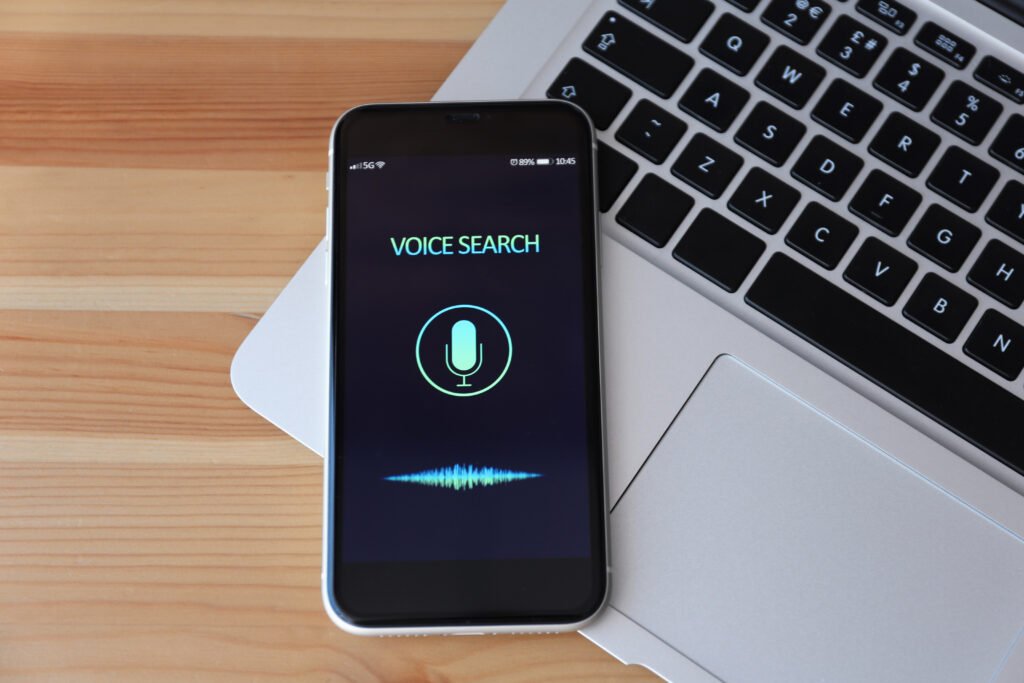
The importance of semantics and context
Google no longer focuses only on the exact word, but on what you mean. Thanks to models such as BERT and MUM, the search engine understands the context. For this reason, SEO and voice search requires that we stop writing for robots and start writing for people who ask questions.
Strategic pillars to master SEO and voice search
For your strategy to succeed at our SEO agency in Spain, we follow a roadmap based on authority and technical relevance. Here are the points you should audit on your site today:
1. Optimization for “Zero Click” and featured snippets
When you ask a question by voice, the assistant does not read you a list of ten results: it reads the first one. Reaching “Position Zero” is the ultimate goal of SEO and voice search.
Pro tip: Use numbered lists or tables. Assistants love reading structured steps.
How to achieve it: Structure your content with direct questions (H2 or H3) followed by a concise answer of around 40–50 words.
2. Local SEO: Voice search’s best friend
Most voice searches have local intent: “near me”, “in my city”. For this reason, having a 2026 local SEO guide strategy is non-negotiable.
- Google Business Profile: Keep your listing updated to the minute. Opening hours, photos, and, above all, reviews.
- NAP (Name, Address, Phone): Your name, address, and phone number must be identical across the entire web.
3. Structured data markup (Schema.org)
To help search engines understand what your website is about, you must “speak” to them in their language. The use of microdata is vital for SEO and voice search. There is a specific property called “Speakable”, which indicates to engines which sections of your content are suitable to be read aloud. Implementing this correctly can be the difference between being invisible and being the result Alexa chooses. You can consult the official technical documentation on structured data in Google Search Central.

Experience and trust in voice search:
As you know, at WeLoveWeb we take authority very seriously. Google will not recommend by voice a website that does not appear trustworthy. To strengthen your E-E-A-T importance in SEO, you must demonstrate that you are an expert in your field.
- Real-world cases: Do not say you can do something: show how you have done it. Including testimonials and trust badges improves the perception of your site.
- Authorship: Articles should be signed by real people with proven track records. This helps Google connect the “Entity” (the author) with “Knowledge”.
The technical side: Speed and UX
If your website takes more than two seconds to load, the voice assistant will move on to the next result. In SEO and voice search, technical performance is critical.
- Core Web Vitals: It is not just a Google metric; it is a user metric. If you want to know how to improve, take a look at our article on Core Web Vitals.
- Mobile responsiveness: Voice search is performed mostly on mobile devices. If your technical SEO is not up to standard, your rankings will suffer.
How to carry out a voice audit for your website (Step by step)
I do not want this article to remain theoretical. I want you to know what to do when you finish. Here is a simple process we apply in our SEO agency in Spain:
- Identify long-tail questions: Use tools such as AnswerThePublic or the Search Console search terms report. Look for phrases that start with “How…?”, “Which…?”, “Where…?”.
- Create an FAQ section: It is the perfect format for SEO and voice search. Group your customers’ most common questions and answer them clearly.
- Analyze response speed: Use PageSpeed Insights, focusing on interaction time.
- Review your eCommerce content: If you sell products, make sure your descriptions address usage questions. SEO for eCommerce in 2026 is closely tied to resolving quick voice queries.
The future: Visual search and voice combined
Looking at SEO trends for 2026, we see that voice search is merging with computer vision (Google Lens). The user will be able to say: “Where can I buy this?” while pointing their camera. The key here is consistency in your image metadata and the strength of your link-building strategy.
Computational linguistics, as detailed in various studies, teaches us that the more natural we are in our digital communication, the better machines will understand us. SEO is no longer about tricking the algorithm, but about being the most human answer possible.
Summary: The 3 pillars of SEO and voice search
- Naturalness: Use conversational language.
- Structure: Answer questions directly and use Schema.
- Speed: If you are not fast, you do not exist for assistants.
Would you like your business to be the dominant voice on Google?
Understanding SEO and voice search is essential, but executing it with precision requires expertise and advanced tools. At WeLoveWeb, we are passionate about helping companies navigate these technological changes.
If you want your brand to stop being just another option and become the answer that virtual assistants recommend to your customers, we are here to help. As an SEO agency in Spain, we design strategies that combine technical rigor with a creative marketing vision. Let us talk today and give your digital success a voice.
FAQ: Frequently asked questions about SEO and voice search
Unlike traditional SEO, the best voice keywords are “long-tail” keywords and those phrased as natural questions. For example, instead of “leather shoes”, you should optimize for “Which are the best leather shoes made in Spain?”.
Not necessarily; sometimes it is enough to restructure what you already have. Adding an FAQ section or rewriting your H2 headings as questions often delivers excellent results without having to start from scratch.
It has a positive impact if you are optimized, as voice-search users are typically closer to a purchase decision or need to resolve a critical question that prevents them from moving forward in the checkout process.
Not always. While Google Assistant uses Google’s index, Alexa primarily uses Bing for its searches. For this reason, a comprehensive SEO strategy should also consider optimization for other search engines.
It is critical. Voice assistants look for the fastest answer to keep the conversation flowing. A slow website will be almost automatically discarded in favor of a competitor that provides the information instantly.